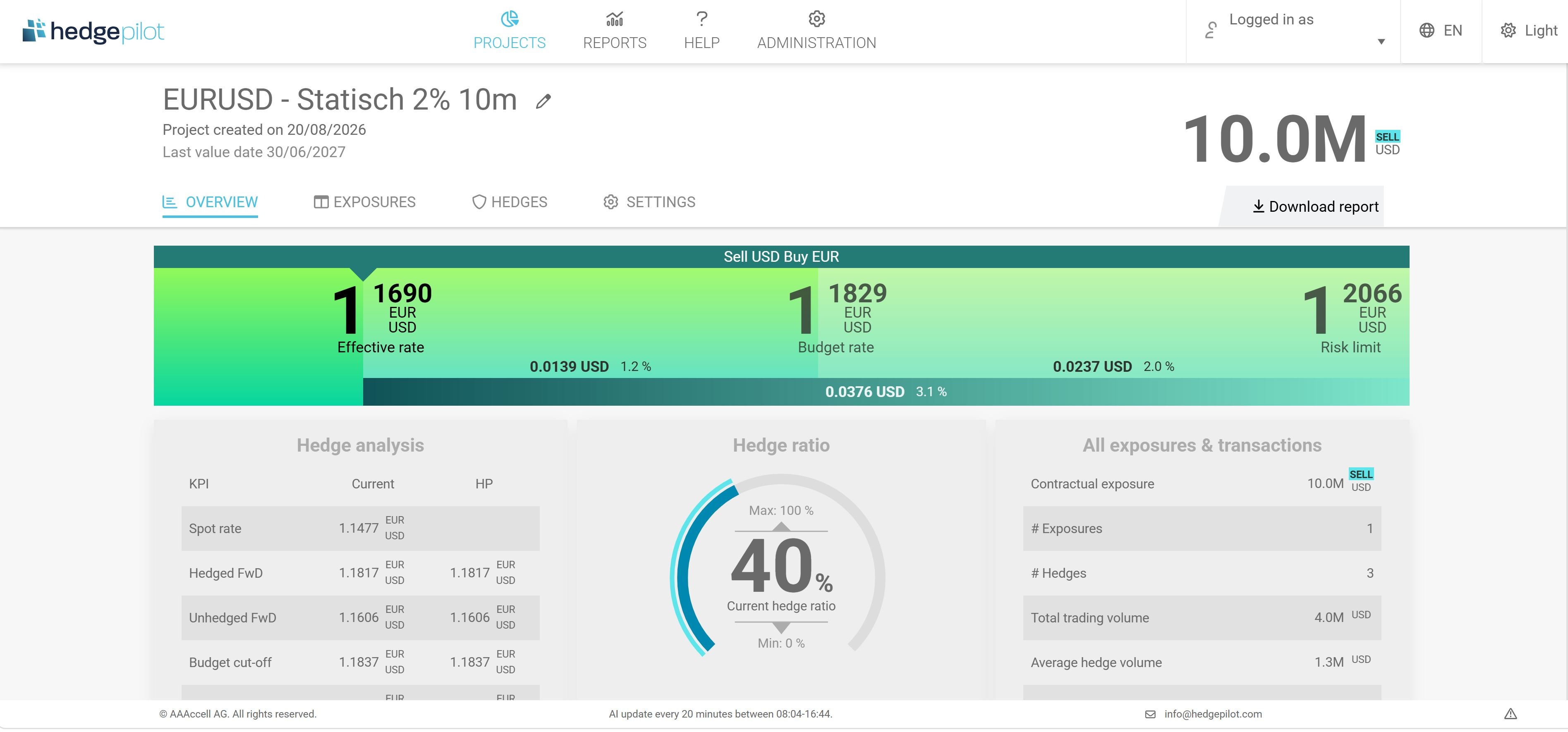
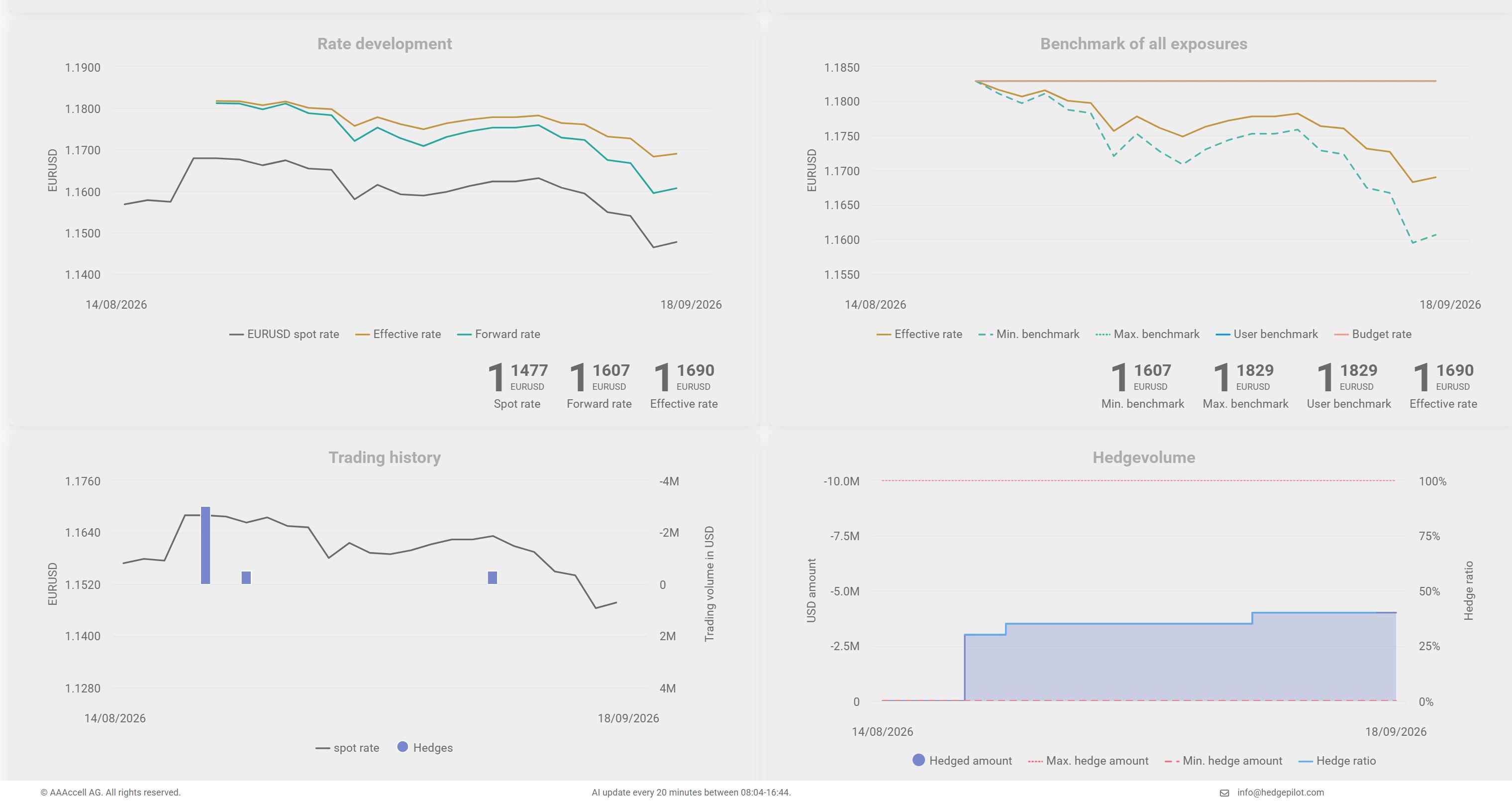
Banks have been losing foreign-exchange (FX) hedging revenue to platforms such as 360T, while smaller companies were typically offered no hedging at all. HedgePilot, developed by a team of around 12 engineers across Barcelona, Germany and Switzerland, offered those smaller companies automated, AI-driven hedging recommendations through a simple dashboard, with execution routed back through the bank’s own infrastructure. In backtests its adaptive, closing-only engine consistently beat two fixed benchmarks, and the commercial side produced first revenue and a second contract with two of the five largest German banks.
The segment the platforms left open
Banks have been losing FX-hedging revenue to platforms such as 360T, which let companies hedge directly by providing web-based trading technology and services for over-the-counter FX, derivatives and short-term money market products to corporate treasuries. At the same time, smaller companies typically were not offered any FX hedging, or did not do any, which left an underserved segment.
HedgePilot’s premise addressed both gaps at once: automated, AI-driven hedging recommendations delivered through a simple dashboard, cheap enough to provide without a client advisor, while the actual FX forward execution was routed back through the bank’s own infrastructure. The intended result was a new segment for the bank and a return of flow to it.
A distributed team across three countries
AAAccell provided the algorithmic development for the hedging engine, in an initial partnership with LPA, which had built the front end and contributed banking and market expertise. Following the acquisition reported by Greater Zurich Area, AAAccell took over the lead of the project.
During my time as a product manager, the project ran in a classic agile setup: around 12 engineers, one UX designer, a product owner, and a sales and distribution team, spread across Barcelona, Germany and Switzerland.
A ratchet instead of a trading desk
Consider a company that expects EUR revenue and needs USD at a future date. Using FX forwards, contracts that fix an exchange rate today for a future date, it can hedge any fraction of that exposure at any point before the date. Hedging 100% locks in a rate with zero risk but no upside if the currency moves favourably; hedging 0% keeps full upside and full downside. The right fraction is knowable only in hindsight, once the actual path of the currency pair is known, so that the task is a sequential decision problem under uncertainty rather than a one-shot choice.
The most distinctive design choice is that the hedge ratio, the fraction of the exposure covered, moves in one direction only. The image used here is that of a ratchet, a mechanism which permits motion in one direction only. Starting at 0% hedged, the position can only be closed incrementally as maturity approaches, meaning that each step raises the hedge ratio, and it can never be reopened. Only FX forwards are used, only closing is permitted, and the engine never sells into a directional bet. This is not a trading algorithm.
The ratchet serves three purposes. It keeps the product firmly within the territory of hedging a known exposure rather than drifting into speculative or directional trading, which is a deliberate regulatory and mandate boundary, since a directional bet would carry different licensing and risk-control requirements entirely. It collapses the action space at each step to two options, close some increment now or wait, which narrows what the utility function has to reason about. And it matches a realistic institutional risk posture: managing an exposure down to certainty by maturity.
Utility in place of prediction
Rather than predicting the FX rate and hedging accordingly, the engine evaluates the utility of a hedging action at each point in time, given the current state of the exposure and the current information set. That sidesteps point-forecasting and asks instead: given everything known now, and the range of futures still possible, what is the expected value of each available adjustment to the hedge ratio? It is an expected-utility-maximisation formulation, similar in spirit to portfolio theory, except that the portfolio here is a single exposure whose hedge ratio evolves over time and whose payoff crystallises only at maturity.
Because that payoff depends on the entire path the currency pair takes, the utility function, U(state, action), approximated as the expected payoff at maturity given the current hedge ratio, the action taken now and the market state, has no closed form, meaning no solution that can be written down analytically. A neural network was therefore trained to approximate it, which is the standard approach when a value function cannot be computed analytically: simulate many trajectories, compute the realised payoffs, and fit a function approximator to the resulting distribution. The construction is conceptually close to a Q-function in reinforcement learning, a function that estimates the expected value of an action in a given state, although the training data here came from Monte Carlo simulation and supervised fitting rather than from a reinforcement-learning loop.
Monte Carlo simulation, the repeated random sampling of possible outcomes, supplied the training data at scale: thousands of simulated FX-pair paths over the remaining horizon, each conditioned on a rich feature set of hundreds of structured inputs (rates, implied volatility, gold and commodity prices, macro data) alongside unstructured signals. For each path and each candidate hedge action, the payoff at maturity was computed, producing an empirical distribution of outcomes per state-action pair for the network to learn. The result is cheap to query at decision time, instead of requiring a live re-simulation.
What the backtests showed, and what they did not
The engine is not claimed to beat a perfect-foresight strategy, which is impossible to beat ex post by definition. What it beat, consistently, were the two fixed, non-adaptive benchmarks: always 0% hedged, and always 100% hedged from day one.
That result is, in one sense, expected. An adaptive policy which responds to incoming information, such as updated market data, the evolving forward curve and shifting macro signals, should outperform either static extreme in expectation, because it uses more information than a rule that has to commit at the outset, before anything is known about how the path unfolds. The evidentiary weight therefore rests less on the direction of the improvement than on its size and consistency, which were backtested across many FX pairs and periods, and which made the case for HedgePilot’s approach.
Two roles, one product
My role changed during the project. I joined as one of two product owners and became the leading product manager. The responsibilities that followed can be grouped as (1) leading the commercial side, which generated the first revenue for the newly developed product; (2) helping to initiate the closing of a contract with another client, both being among the five largest German banks; and (3) coordinating a distributed agile team across three countries.
The project achieved what it set out to do: reaching a new client segment for the banks concerned while bringing FX forward flow back in-house. My reading is that the design choice most worth remembering is the ratchet, because it turned a regulatory constraint into a design principle.
Screenshots